
12 August 2026
Palestinian Politics After the Gaza War: Elections, the Decline of Hamas, and Changing Prospects for Israeli-Palestinian Peace
PSR findings point to a Palestinian political landscape in transition. Hamas has lost substantial public support, while Marwan Barghouti emerges as the strongest potential presidential candidate and dissatisfaction with the existing leadership remains exceptionally high. At the same time, Palestinians increasingly question whether armed struggle has delivered meaningful results after the devastation of Gaza, contributing to a notable rise in support for negotiations. Yet this shift remains fragile: most Palestinians still oppose Hamas disarmament before full Israeli withdrawal from the Gaza Strip, view settlement expansion as undermining the two-state solution, and remain deeply skeptical of both Palestinian and Israeli leadership.
5-8 September 2025
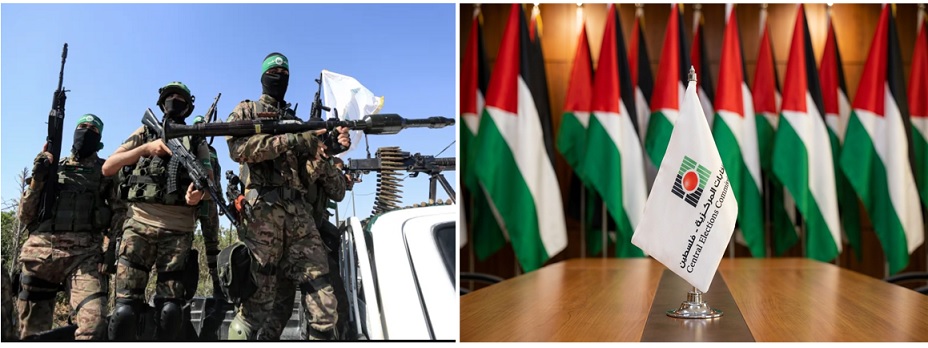
These are the results of the latest poll conducted by the Palestinian Center for Policy and Survey Research (PSR) in the West Bank and the Gaza Strip between 5 and 8 August 2026. The period preceding the survey witnessed the announcement of Palestinian legislative elections to be held on November 28, 2026, and presidential elections in early 2027. Hamas also announced its acceptance of the Nikolay Mladenov Plan to begin the second phase of the Trump Gaza Plan, including the movement’s relinquishing of its weapons. Israeli elections were scheduled for the end of October 2026. During this period, Fatah held its Eighth General Conference and elected a new Central Committee, while Hamas elected Khalil al-Hayya as head of its Political Bureau. At the same time, settler attacks in the West Bank escalated to unprecedented levels under the protection of the Israeli government, while settlers and the Israeli government intensified efforts to expand settlements and establish new outposts. Domestically, the West Bank public was affected by a major fuel crisis that resulted in long lines of cars at gas stations. Externally, the United States attacked Iran, initially jointly with Israel at the end of February 2026 and later on its own. Restrictions on Palestinian movement in the West Bank continued, with the Israeli army closing the entrances to most towns and villages to prevent residents from reaching major roads.
The survey covers all of the above issues, as well as other topics including domestic conditions, the internal balance of power, the peace process, and the alternatives available to Palestinians in light of the current stalemate in that process.
The survey was conducted face-to-face in both the West Bank and Gaza Strip using tablets or mobile phones. Upon completion of each interview, the data were automatically transmitted directly to our server, which can be accessed only by our researchers. There is no way for anyone to intercept or manipulate the collected data. The sample consisted of 1,270 respondents: 830 interviewed in the West Bank across 83 residential localities and 440 in the Gaza Strip across 44 localities. The margin of error was 3.5%.
To ensure the safety of our field researchers in the Gaza Strip, interviews with residents were conducted in areas west, south, and north of what has become known as the “Yellow Line,” areas where there is no Israeli military presence. Interviews with residents of areas under Israeli military occupation, such as Rafah and parts of northern Gaza and Khan Younis, were conducted in shelters.
For further details, contact PSR director, Dr. Khalil Shikaki, or Walid Ladadweh at tel. 02-296 4933 or email pcpsr@pcpsr.org
Summary of the Main Findings: |
The survey shows a Palestinian political landscape marked by continued rejection of the existing leadership, declining Hamas popularity, and growing uncertainty about the political future. If elections were held today, Marwan Barghouti would be the strongest presidential candidate, followed by Khalil al-Hayya and Mahmoud Abbas. Fatah and Hamas are now tied at a quarter each in general partisan identification, but Hamas has lost more than ten points in ten months. The decline is particularly pronounced in the West Bank, where Hamas support fell from about a third to about a fifth, while in Gaza it declined to one third. Thus, the political picture is not simply a shift from Hamas to Fatah: dissatisfaction with both major movements is substantial, with a large percentage saying that neither deserves to represent or lead the Palestinians.
The Gaza war has also altered perceptions of Hamas. Only one fifth of the public now believes Hamas won the war, compared with twice that share ten months earlier; six in ten believe neither side won. Yet this does not translate into support for immediate disarmament. About three quarters oppose Hamas disarming before a complete Israeli withdrawal, and the same percentage believe that disarmament would lead to renewed war rather than Israeli withdrawal. Following Hamas’s acceptance of the Nikolay Mladenov’s proposal as part of the Trump Plan, four out of ten expect the current situation—with continued killings—to persist, while only three out of ten anticipate genuine stability and reconstruction. At the same time, the Houthis, Hezbollah, and Iran receive relatively high satisfaction, while Trump and Abbas receive very low ratings. This suggests that Palestinian appreciation is increasingly shaped by perceptions of resistance and opposition to Israel rather than by formal diplomatic influence.
Domestically, the picture is bleak: more than three quarters feel unsafe, an overwhelming majority perceives corruption in PA institutions, and about two thirds view the PA as a burden. These attitudes reinforce the broader leadership crisis.
Most strikingly, attitudes toward the peace process show less enthusiasm for armed confrontation and greater interest in negotiations. Support for armed struggle as the most effective means of achieving statehood fell from four out of ten to less than three out of ten, while support for negotiations rose from a little over a third to a little less than half, its highest level in four years. Peaceful popular resistance also increased modestly. This does not mean Palestinians have abandoned armed resistance or become optimistic about peace: half still believe armed resistance has been effective, and about six out of ten believe the two-state solution is no longer practical. Rather, the findings suggest a growing recognition that, after the devastation of Gaza and the failure to achieve decisive results through armed struggle, negotiation may currently offer the more promising path—even as confidence in the existing Palestinian and Israeli political leadership remains extremely low.
The following is a summary of the main findings:
1. Palestinian Political Landscape: The survey points to continued dissatisfaction with the Palestinian political leadership, but also to a significant reshuffling of political preferences. Marwan Barghouti is the strongest potential successor to President Mahmoud Abbas, preferred by 39%, followed by Hamas leader Khalil al-Hayya at 16%, Mohammed Dahlan at 15%, and Mustafa Barghouti at 6%. In a hypothetical presidential election, Marwan Barghouti would receive 54% from among the likely voters, al-Hayya 26%, and Abbas only 14%. At the same time, 79% want Abbas to resign, confirming the persistence of exceptionally high dissatisfaction with his leadership.
Hamas has also experienced a significant decline in popularity. Its overall support has fallen to 24%, compared with 35% ten months earlier, while Fatah remains at 24%. Among likely voters, Fatah would receive 32% and Hamas 29%, with third forces receiving 18%. Confidence in Hamas's ability to represent Palestinians has also declined, from 41% to 28%, while 44% now say that neither Hamas nor Fatah deserves to lead. These findings suggest that dissatisfaction is increasingly directed not toward one faction alone but toward the broader Palestinian political system.
2. Gaza War and the Trump Plan: The survey shows a major shift in perceptions of the Gaza war. Only 20% believe Hamas emerged victorious, 15% believe Israel did, and 60% believe neither side won. This represents a sharp decline in perceptions of a Hamas victory, particularly in the West Bank, where only 21% now see Hamas as victorious compared with 48% ten months earlier.
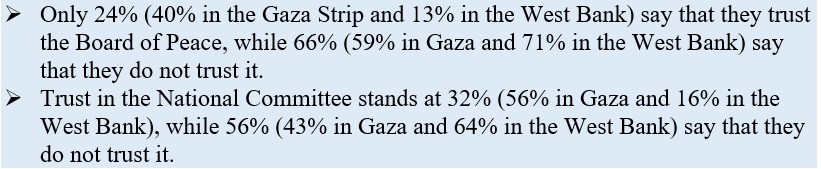
Despite this, 72% oppose Hamas disarming before Israel fully withdraws from Gaza, and the same percentage believe that disarmament would lead to renewed war rather than Israeli withdrawal. Public confidence in the institutions established under the Trump Plan is limited: only 24% trust the Board of Peace and 32% trust the National Committee for the Administration of Gaza. Palestinians therefore appear receptive to an end to the war but skeptical about the proposed mechanisms for governing Gaza afterward.
Satisfaction with Hamas’s performance during the war has fallen sharply, from 60% to 42%, while satisfaction with Abbas stands at only 18%. Among regional actors, the Houthis receive the highest satisfaction at 61%, followed by Qatar at 51%, Hezbollah and Iran at 50%. Spain leads among international actors at 50%, followed by China at 40%, while satisfaction with Trump remains extremely low at 5%.
3. Domestic Conditions: Domestic insecurity and dissatisfaction with Palestinian governance remain pronounced. Only 23% feel personally and familiarly safe, while 76% feel unsafe. A striking 83% believe corruption exists within Palestinian Authority institutions, and 65% now describe the PA as a burden rather than an achievement. Most respondents also see little meaningful change resulting from the recent Fatah and Hamas leadership elections.
4. Palestinian-Israeli Relations and the Peace Process: Support for the two-state solution stands at 44%, while 50% oppose it—virtually unchanged from ten months earlier. Yet support for a specific two-state formula based on the 1967 borders is considerably higher, at 56%, including 61% in Gaza. Confederation receives 14% and a single democratic state with equal rights 10%. At the same time, 58% believe the two-state solution is no longer practical because of settlement expansion, and 64% see little or no chance of an independent Palestinian state emerging within five years.
There is nevertheless a notable shift in preferred strategies for achieving Palestinian statehood. Negotiations are now viewed as the most effective approach by 44%, up from 36% ten months earlier and the highest level in four years. Support for armed struggle has fallen from 41% to 27%, its lowest level in four years, while support for peaceful popular resistance has risen from 14% to 19%. However, Palestinians remain evenly divided over whether armed resistance has been effective, with 50% saying it has failed to protect Palestinians or end the occupation and 50% rejecting that assessment.
5. The US-Iran War: The recent US-Iran war has produced a distinctly favorable Palestinian orientation toward Iran: 45% say they sided with Iran, compared with only 12% who sided against it, while 40% sided with neither Iran nor the United States.
6. Palestinian Top Priorities: The survey reveals that statehood remains the leading national aspiration. Forty-three percent identify Israeli withdrawal to the 1967 borders and establishment of a Palestinian state with East Jerusalem as its capital as the Palestinian people's highest priority. Twenty-eight percent prioritize the right of return, 15% emphasize building a religious society based on Islamic teachings, and 11% prioritize democratic government and human rights.
In brief, the survey depicts a Palestinian public deeply dissatisfied with its political leadership and profoundly insecure, yet increasingly skeptical of the effectiveness of armed confrontation. The combination of declining support for Hamas, growing preference for negotiations, continued attachment to the 1967-based two-state framework, and strong opposition to Hamas disarmament before Israeli withdrawal suggests that Palestinians may be moving toward a more pragmatic conception of conflict resolution—but without abandoning core national demands or developing confidence in the political actors currently expected to deliver them.
| Main Findings |
(1) Palestinian Legislative and Presidential Elections and the domestic Balance of Power |
- Forty-nine percent say they believe that the legislative elections will indeed be held next November, while 44% believe that the elections will not be held on schedule. The expectation that the elections will take place as scheduled is higher in the Gaza Strip than in the West Bank: 55% and 45%, respectively. Ten months ago, in our previous October 2025 poll—before a date had been set for the legislative elections currently being prepared for—a majority of Palestinians (60%) said that the Palestinian Authority did not intend to hold presidential and legislative elections within a year, while only one-third believed that the Palestinian Authority would actually hold these elections.
- However, two-thirds of the public believe that, if held, these elections will not be free and fair, while only 30% believe that they will be free and fair. The expectation that the elections will be free and fair is higher in Gaza than in the West Bank: 39% and 24%, respectively.
- A majority of 54% believe that the upcoming legislative elections should be held even if Israel refuses to allow them to take place in East Jerusalem, because Jerusalem residents could vote at any polling station in the West Bank. However, 37% believe that the elections should not be held if Israel prevents them from taking place in East Jerusalem.
- Two-thirds oppose requiring candidates to accept the Palestine Liberation Organization’s commitments, including its agreements with Israel, as a condition for running in the elections. Only 27% support such a requirement. Support for this condition is higher in Gaza than in the West Bank: 35% and 21%, respectively. Ten months ago, 63% opposed imposing such a condition.
- The largest proportions of respondents identify the following as the top priorities that the upcoming legislative elections should address: unifying the West Bank and Gaza (19%), stopping the killing in the Gaza Strip (18%), improving the economic situation (15%), rebuilding Gaza (11%), confronting settler terrorism (10%), and combating corruption (9%). When asked which movement or electoral list would be best able to achieve the priority they selected, 25% say Hamas is best able to do so, while 19% say Fatah, 12% say a third party, 16% say all of these parties would be equally capable, and 28% say none would be capable.
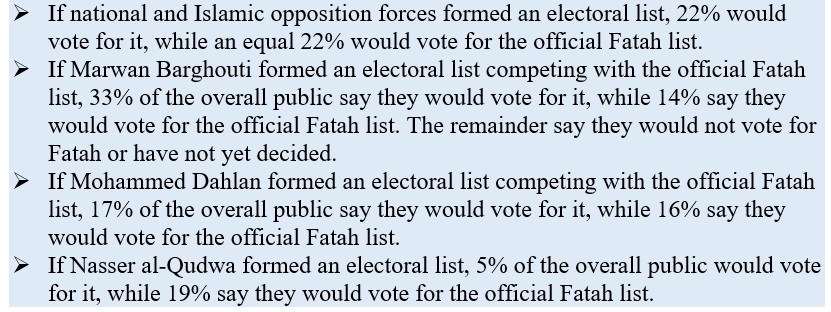
- We presented the public with different scenarios regarding the upcoming electoral competition to determine their preferred choices under each scenario:
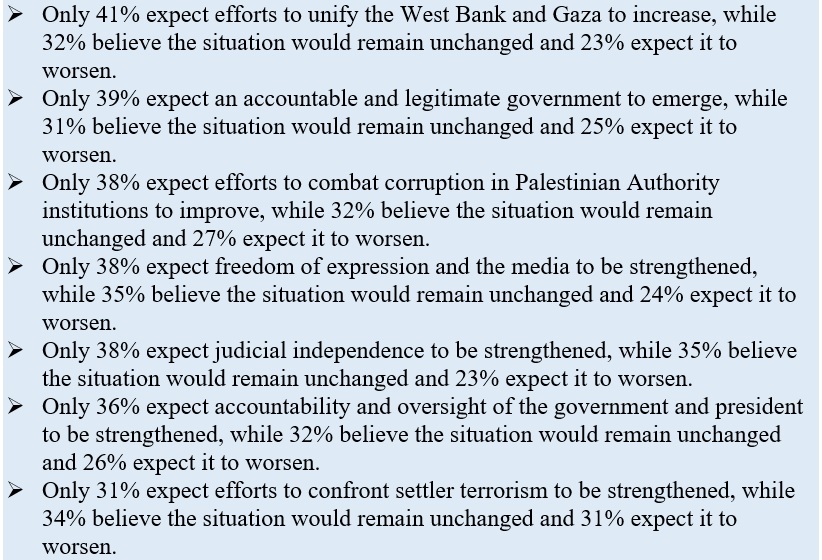
- If new legislative elections were held today and a new government were formed, the largest proportion (44%) expects this to improve economic conditions, while 29% believe conditions would remain unchanged and 23% expect them to worsen. However, this optimism declines when respondents are asked about domestic political issues or expectations regarding efforts to confront settler terrorism:
- If new Palestinian Authority presidential elections were held today and the candidates were President Mahmoud Abbas, Hamas leader Khalil al-Hayya, and Fatah prisoner Marwan Barghouti, Barghouti would receive 54% from among likely voters, followed by al-Hayya with 26% and President Abbas with 14%. Support for Barghouti rises among likely voters to 63% in the West Bank, while support for al-Hayya rises to 38% in Gaza. Ten months ago, among likely voters, Marwan Barghouti received 49%, followed by Khaled Mashal with 36% and President Abbas with 13%. The following figure presents the vote among the entire public, including those who would not participate in the election.

- Satisfaction with President Abbas’s performance stands at 20%, compared with 23% ten months ago, while dissatisfaction stands at 76%. Satisfaction with Abbas stands at 16% in the West Bank, compared with 18% ten months ago, and at 26% in Gaza, compared with 31% ten months ago.
- Seventy-nine percent say they want President Abbas to resign, while 16% want him to remain in office. Ten months ago, 80% wanted the president to resign. Today, the demand for Abbas’s resignation stands at 82% in the West Bank and 74% in Gaza. As shown in the following figure, the demand for President Abbas’s resignation over the past three years has ranged between 79% and 89%.

- In a closed-ended question, we asked the public to choose the person they considered most suitable to succeed President Abbas from a predetermined list of options. The largest proportion (39%) preferred Marwan Barghouti, 16% preferred Khalil al-Hayya, the head of Hamas, 15% chose Mohammed Dahlan, and 6% chose Mustafa Barghouti. Twenty-five percent said they did not know or selected someone else.
- If legislative elections were held in which all electoral lists or factions that participated in the 2006 elections competed, turnout would be 66%. Among those who would participate, Fatah would receive 32%, followed by Hamas (Change and Reform) with 29%, all third parties combined with 18%, while 21% have not yet decided whom they would support. In Gaza, Hamas would receive 34% among voters, Fatah 30%, and the combined third parties 27%, while 10% remain undecided. In the West Bank, 34% of voters say they would vote for Fatah, 25% for Hamas, 10% for the combined third parties, and 32% remain undecided.
Ten months ago, 44% said they would vote for Hamas, 30% for Fatah, 10% for the third parties, and 16% were undecided. At that time in Gaza, Hamas received 49% among voters and Fatah 32%. In the West Bank, Hamas received 40% and Fatah 29%. The following figure presents voting preferences among the entire public, including those who would not participate in the election.

- When asked which political party or political orientation they support, 24% said they preferred Fatah, an identical 24% preferred Hamas, 14% chose third parties, and 38% said they supported none of them or did not know. Ten months ago, 35% said they supported Hamas and 24% supported Fatah. Today, support for Hamas stands at 18% in the West Bank, compared with 32% ten months ago, while support for Fatah stands at 23%, compared with 20% ten months ago. In Gaza, support for Hamas stands at 33%, compared with 41% ten months ago, while support for Fatah stands at 26%, compared with 29% ten months ago. These findings indicate that support for Hamas has declined substantially over the past ten months, by 11 percentage points, while Fatah has maintained roughly the same level of support. Hamas support declined by 14 points in the West Bank and by 8 points in Gaza.

- In parallel with its declining popularity among the Palestinian public, confidence in Hamas’s ability to lead the Palestinian people has also declined. Nevertheless, confidence in Hamas’s suitability to represent and lead the Palestinian people remains higher than confidence in Fatah under President Abbas. Only 28%—compared with 41% ten months ago—believe that Hamas is the party most deserving of representing and leading the Palestinian people today, while 21%—compared with 22% ten months ago—believe that Fatah under President Abbas is most deserving. Forty-four percent, compared with 31% ten months ago, believe that neither is worthy of representing and leading the Palestinian people
(2) The War in Gaza and the Trump Plan |
1. Expectations about who emerged victorious |
- Only 20% say that Hamas emerged victorious from the war in Gaza, while 15% say that Israel emerged victorious, and 60% say that neither side emerged victorious. In the Gaza Strip, 20% say that Israel emerged victorious, while an identical 20% say that Hamas emerged victorious. In our previous survey ten months ago, in October 2025, 39% said that Hamas had emerged victorious. As shown in the figure below, the largest decline in expectations of a Hamas victory occurred in the West Bank, where only 21% now hold this view, compared with 48% ten months ago.

2. Attitudes toward Hamas giving up its weapons |
- An overwhelming majority (72%) say that Hamas should not disarm before Israel fully withdraws from the Gaza Strip, while only 20% say that it should do so. Opposition to Hamas disarming before a complete Israeli withdrawal stands at 62% in the Gaza Strip and 79% in the West Bank. Ten months ago, a large majority of 69% (78% in the West Bank and 55% in the Gaza Strip) opposed Hamas disarming, while only 29% supported it.
- An overwhelming majority (72%) believe that if Hamas were to disarm, the war in Gaza would resume and Israel would not fully withdraw from the Gaza Strip. Only 22% believe that, in this case, the war would not resume and Israel would fully withdraw from Gaza.
- A majority of 53% believe that if Hamas gives up its weapons, it would remain both an armed resistance movement and a political movement, while 36% believe that it would then become solely a political movement.
- Now that Hamas has agreed to the plan proposed by Peace Council envoy Mladenov for the second phase of the Trump Plan, including agreeing to disarm, the largest percentage (41%) expects the current situation to continue, with some continued killings. Meanwhile, 30% believe that calm and stability will prevail in the Gaza Strip, that the National Committee will enter Gaza, and that reconstruction will begin. In contrast, 21% believe that full-scale war will resume.
3. Trust in the Board of Peace and the National Committee for the Administration of Gaza |
- We asked the public how much they trust the Board of Peace overseeing implementation of the Trump Plan for Gaza, as well as how much they trust the National Committee for the Administration of Gaza.
- If the Palestinian elections scheduled for November were held as planned and a new government were formed, only 28% (34% in Gaza and 24% in the West Bank) would prefer this elected government to assume responsibility for administering the Gaza Strip. A larger percentage, 32% (43% in Gaza and 24% in the West Bank), would prefer the National Committee to remain responsible for Gaza, while 34% do not prefer either option. It is worth noting that support for establishing the National Committee stood at 51% in Gaza and 41% in the West Bank ten months ago.
4. Satisfaction with Palestinian, regional, and international actors |
- As in previous surveys, we asked respondents to assess their satisfaction with the roles played during the war by Palestinian, Arab/regional, and international actors.
On the Palestinian side, satisfaction with Hamas's performance has declined sharply, standing today at 42% (45% in the West Bank and 38% in Gaza), compared with 60% ten months ago (66% in the West Bank and 51% in Gaza). Satisfaction with Fatah remains roughly unchanged from ten months ago, at 30% (25% in the West Bank and 34% in Gaza). Satisfaction with President Abbas has declined to 18% (14% in the West Bank and 24% in Gaza), compared with 21% ten months ago.

- Among Arab and regional actors, the highest level of satisfaction is with the Houthis in Yemen, as found in our previous surveys, at 61% (63% in the West Bank and 58% in Gaza), followed by Qatar (51%), Hezbollah (50%), and Iran (50%). These findings indicate an increase in satisfaction with Iran, stable levels of satisfaction with the Houthis and Hezbollah, and a significant decline in satisfaction with Qatar compared with ten months ago.
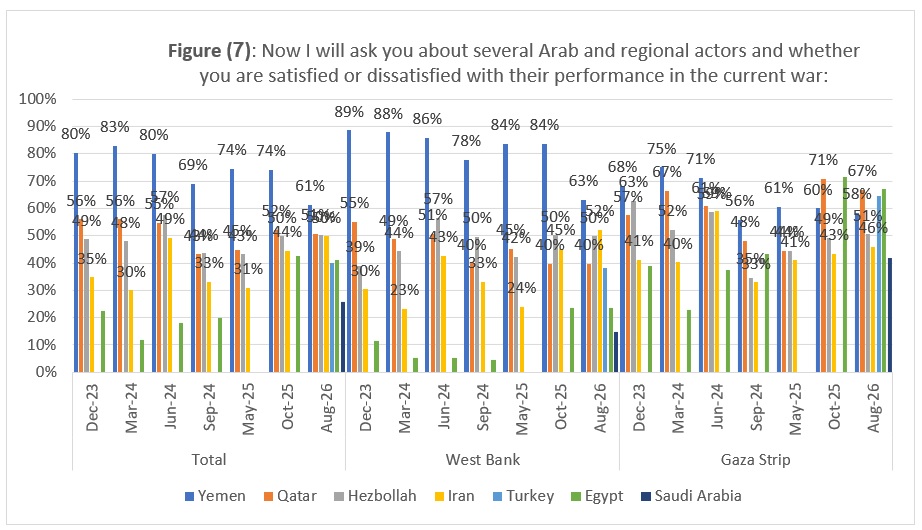
- Among international actors outside the region, Spain received the highest level of satisfaction (50%), followed by China (40%) and President Trump (5%). Ten months ago, satisfaction with Spain stood at 35%, with China at 34%, and with Trump at 5%.

3) Domestic Conditions |
- We asked respondents in the West Bank and Gaza Strip about their personal and family safety and security. The findings show that 23% (17% in the West Bank and 31% in Gaza) feel safe and secure, while 76% feel unsafe and insecure.
- 83% believe that there is corruption in Palestinian Authority institutions, including 87% in the West Bank and 77% in Gaza. Ten months ago, 80% said that there was corruption in the Palestinian Authority.
- Al Jazeera is the most-watched television channel in Palestine, with 46% identifying it as the channel they watched most during the past two months. West Bank residents are more likely than Gaza residents to watch Al Jazeera, given the current circumstances of the war: 58% of West Bank residents and 28% of Gaza residents identify it as their preferred channel. The second most popular channel is Al Arabiya (5%), followed by Palestine Today (3%), Palestine TV (2%), and Al-Manar, Al-Aqsa TV, and Ma'an TV, each at 1%.
- A majority of 65%, compared with 56% ten months ago, believe that the Palestinian Authority has become a burden on the Palestinian people. Only 29%, compared with 40% ten months ago, believe that it is an achievement for the Palestinian people.
- The largest share of the public (33%) says that the elections of Fatah's Eighth General Conference produced little meaningful change in the movement's leadership. 10% say that the leadership has become better, while 16% say that it has become worse. 42% say that they did not follow the conference proceedings or have no opinion about them.
- The situation is not very different regarding the Hamas elections, which resulted in the selection of Khalil al-Hayya as the movement's leader. 30% say that the elections produced no change in Hamas's leadership, while 14% say that the leadership has become better and 13% say that it has become worse. 43% say that they did not follow the Hamas elections or have no opinion about them.
- We asked respondents in the West Bank who they consider primarily responsible for the shortage of gasoline and diesel and the long lines at fuel stations. We presented four possible explanations: Israel, because it restricts Palestinian access to fuel; government agencies, because of their poor performance in ensuring fuel supplies; drivers, because they rushed to stockpile fuel; and fuel merchants and gas-station owners, because of greed. The largest percentage (48%) blamed government agencies, followed by Israel (26%), fuel merchants and gas-station owners (17%), and finally drivers (4%).
4) Palestinian-Israeli Relations and the Peace Process |
- 44% support and 50% oppose the two-state solution, with the solution presented to respondents without providing any additional details about it. Ten months ago, 45% supported the solution when asked the same question. Support in the current survey is almost identical in the West Bank and the Gaza Strip.
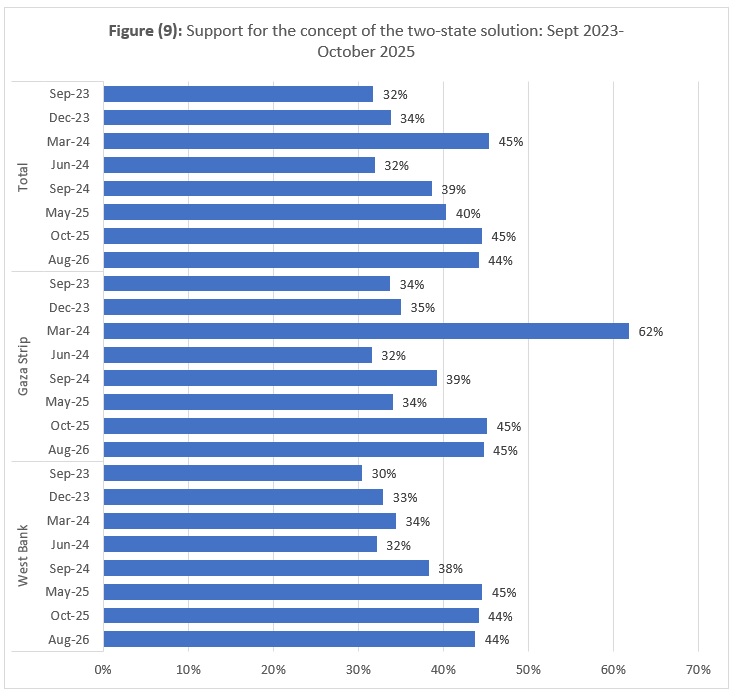
- Support for the two-state solution is usually linked to public assessments of its practicality or feasibility and the prospects for establishing a Palestinian state. A total of 58% (compared with 56% ten months ago) say that the two-state solution is no longer practical because of settlement expansion, while 36% (compared with 41% ten months ago) believe that it remains practical. Similarly, 64% say that the chances of establishing an independent Palestinian state alongside Israel within the next five years are low or nonexistent, while 32% say that the chances are medium or high.
- When asked about three possible solutions—the two-state solution based on the 1967 borders, confederation between the states of Palestine and Israel, and one state in which Jews and Palestinians live with equal rights—56% (52% in the West Bank and 61% in the Gaza Strip) said they preferred the two-state solution based on the 1967 borders. 14% (9% in the West Bank and 22% in Gaza) preferred a confederation between the two states, while 10% (10% in both the West Bank and Gaza) preferred a single state with equal rights for both sides. 20% said they did not know or declined to answer. In our previous survey in October 2025, support for a two-state solution based on the 1967 borders was below half, at 47%.
- When asked about support for or opposition to specific political measures intended to break the current deadlock, 67% supported joining additional international organizations, 54% supported resorting to nonviolent popular resistance, 36% supported a return to confrontations and armed intifada, 51% supported dissolving the Palestinian Authority, and 33% supported abandoning the two-state solution in favor of a single state for Palestinians and Israelis. In our previous survey ten months ago, 41% supported a return to confrontations and armed intifada, 54% supported nonviolent popular resistance, 45% supported dissolving the Palestinian Authority, and 27% supported abandoning the two-state solution in favor of a one-state solution.
- We presented respondents with three ways of ending the Israeli occupation and establishing an independent Palestinian state and asked them to select the most effective:
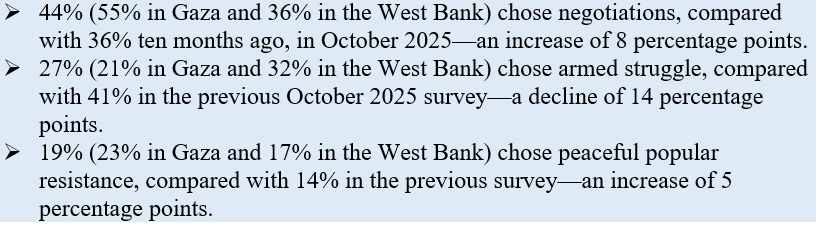
- As shown in the figure below, these findings indicate that support for armed struggle is at its lowest level in four years, while support for negotiations is at its highest level in four years.

- Nevertheless, the findings indicate that the underlying position of roughly half of the public regarding the effectiveness of armed struggle remains supportive. The Palestinian public is divided into two exactly equal groups in its assessment of the effectiveness of armed resistance operations carried out by Palestinian factions such as Hamas: half believe that such resistance “has failed to protect Palestinians or end the Israeli occupation, but instead has led to the destruction of the Gaza Strip and refugee camps in the northern West Bank,” while the other half disagree with this assessment. Agreement that armed resistance has been ineffective is higher in the Gaza Strip, at 65%, and lower in the West Bank, at only 35%.
- We asked respondents about the most effective ways of confronting settler violence: relying on the Israeli army to prevent such attacks; deploying Palestinian police forces in areas vulnerable to attacks; forming armed groups among residents of those areas; or forming unarmed groups among local residents. The findings were as follows:

- An overwhelming majority of West Bank residents (87%) are worried or concerned that increasing settlement expansion and the establishment of outposts will result in them losing their land or homes, while 11% say that they are not worried.
- We asked respondents about their expectations regarding Israeli policy toward the Gaza Strip and the West Bank if the Israeli opposition were to win and Netanyahu were to lose the upcoming Israeli election. The public is divided into three relatively similar groups: 34% say that Israeli policy would remain unchanged, 33% say that it would change for the worse, and 28% say that it would change for the better.
5) The Recent War Between the United States and Iran |
- We asked respondents about their position toward Iran—whether they were with or against Iran—during the recent war between the United States and Iran, which resulted in the closure of the Strait of Hormuz and retaliatory attacks against U.S. bases in the region, particularly in several Gulf countries. 45% say that they were with Iran, 12% say that they were against Iran, while 40% say that they were neither with Iran nor with the United States.
6) Palestinian-Israeli Relations and the Peace Process
43% believe that the Palestinian people's highest priority should be achieving an Israeli withdrawal to the 1967 borders and establishing a Palestinian state in the West Bank and Gaza Strip, with East Jerusalem as its capital. In contrast, 28% say that the primary goal should be obtaining the right of return for refugees and enabling them to return to the villages and towns from which they were expelled in 1948. 15% believe that the first and most vital goal should be building a righteous individual and a religious society that fully adheres to the teachings of Islam. 11% say that the goal should be establishing a democratic system of government that respects Palestinian freedoms and human rights.