
14 October 2026
Palestinian Public Opinion Shifts Toward Independent Leadership and Competent Government as Fatah and Hamas Lose Ground
October 2026 Poll Reveals Strong Demand for Electoral Renewal, Economic Recovery, and Effective Governance, alongside Continued Support for Negotiations, Resistance to Premature Disarmament, and Deep Divisions over Gaza’s Political Future and the Path to Palestinian Statehood.
7-11 October 2026
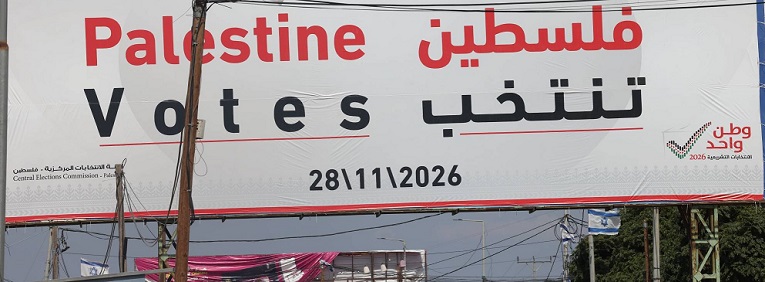
These are the results of the latest poll conducted by the Palestinian Center for Policy and Survey Research (PSR) in the West Bank and the Gaza Strip between 7 and 11 October 2026 exactly two full months after PSR’s Public Opinion Poll No. 97 in August 2026. Fieldwork coincided with an essential electoral development: the official setting of general legislative elections for November 28, 2026, and the formal submission of candidate list registration at the Central Elections Commission (CEC), where various competing electoral lists officially submitted their credentials. However, President Abbas issued a decree on the last day of data collection in which he postponed the elections by about 10 months, to 11 September 2027.
Despite the electoral progression during the data collection period, baseline structural conditions remained aligned with August. Palestinians faced ongoing severe humanitarian and economic repercussions from the Gaza war, West Bank movement restrictions, increased settler violence, and regional instability following US-Iran tensions. Within this environment, this poll provides a baseline of public attitudes, candidate choices, and governance expectations less than two months before the original date set for the national vote.
The survey focuses on the elections and various issues related to Palestinian-Israeli relations.
The survey was conducted face-to-face in both the West Bank and Gaza Strip using tablets or mobile phones. Upon completion of each interview, the data were automatically transmitted directly to our server, which can be accessed only by our researchers. There is no way for anyone to intercept or manipulate the collected data. The sample consisted of 1397 respondents: 909 interviewed in the West Bank across 83 residential localities and 488 in the Gaza Strip across 44 localities. The margin of error was 3.5%.
To ensure the safety of our field researchers in the Gaza Strip, interviews with residents were conducted in areas west, south, and north of what has become known as the “Yellow Line,” areas where there is no Israeli military presence. Interviews with residents of areas under Israeli military occupation, such as Rafah and parts of northern Gaza and Khan Younis, were conducted in shelters.
For further details, contact PSR director, Dr. Khalil Shikaki, or Walid Ladadweh at tel. 02-296 4933 or email pcpsr@pcpsr.org
Summary of the Main Findings: |
The October 2026 Palestinian Election Poll reveals a fundamental structural transformation in public opinion: a significant contraction in direct party affiliation toward historical factions, offset by a major surge in public support for independent electoral lists, professional economic platforms, and technocratic governance frameworks.
Poll findings highlights three core political insights:
(1) Livelihood Voting: Economic hardship and the jump in support for Masri's list (15% to 25% post-profiling) demonstrate pragmatic livelihood voting focused on managerial competence and investment attraction.
(2) Decoupling Diplomacy and Deterrence: Public opinion separates non-victory war evaluations (62%) and endorsement of negotiations (42%) from resisting premature disarming (74%), reflecting balanced strategic realism.
(3) Institutional Renewal: High non-alignment in the West Bank (48%) and technocratic demand in Gaza (60%) show elections provide a vital opportunity to rebuild national legitimacy via independent partnerships.
Below is the analytical synthesis across five core thematic pillars:
1. Electoral participation and youth disengagement gap: Public desire for democratic renewal is strong, with 53% supporting holding elections on schedule on November 28 without delay. An additional 21% favor a short operational postponement of under six months to ensure administrative inclusivity, while 20% oppose holding elections altogether. Overall voter turnout intention stands at 55% among eligible voters (30% definite, 25% likely). However, a sharp generational divide emerges: only 31% of young citizens aged 18–22 report being registered on the voter rolls, and their overall voting intention lags at just 46%, reflecting a concerning political alienation among young voters.
2. Contraction of historical factions and expansion of non-aligned voters: Support for historical party banners continues to erode. When asked about direct party identification, Fatah received 22% support and Hamas received 19%, while a commanding 33% plurality selected 'None of the Above' (reaching 48% in the West Bank compared to 11% in Gaza). This trend underscores a sustained decline in Hamas's standing, which dropped from 35% ten months prior to 24% in August, and now stands at 19% nationally (and just 13% in the West Bank).
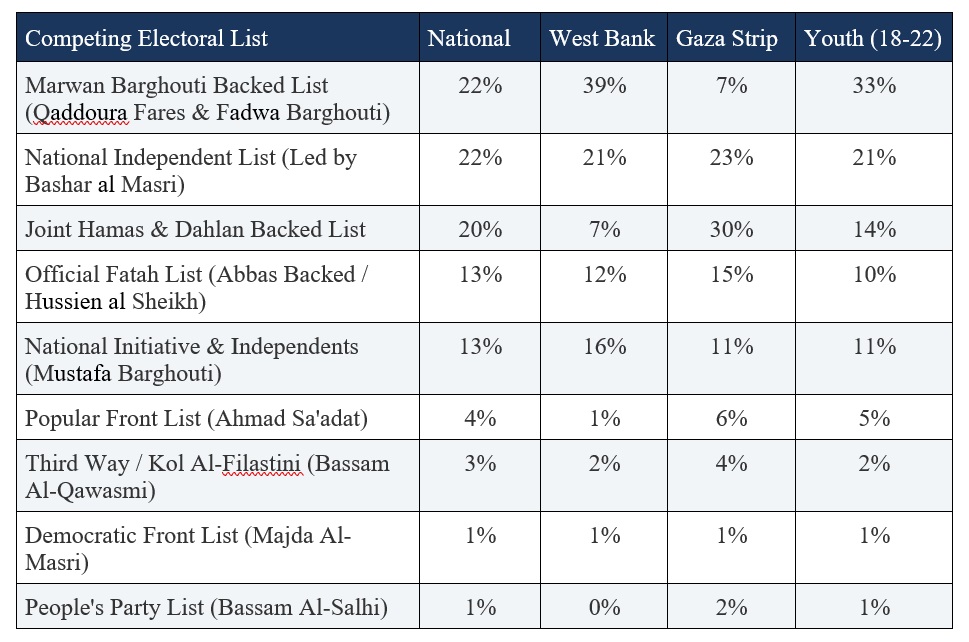
3. Emergence of independent lists and multi-polar competition: A decisive 56% majority expressed explicit willingness to vote for a newly formed independent list comprising professional, economic, and civil figures. When testing nine candidate lists among likely voters who have finalized their choices, the National Independent List led by industrialist Bashar Masri tied for first place with the list backed by imprisoned leader Marwan Barghouti (Qadoura Fares and Fadwa Barghouti), each securing 22% of the vote. Both independent/reformist lists surpassed the Joint Hamas-Dahlan List (20%), Official Fatah led by Hussein al-Sheikh and backed by President Abbas (13%), and the National Initiative led by Mustafa Barghouti (13%).
4. Redefining economic competence and leadership expectations: Experimental profiling demonstrated that informing voters of Bashar Masri's background and economic platform triggered a major shift in voting behavior, driving support for his list from 15% pre-profiling up to 25% post-profiling, placing it ahead of all partisan alternatives. Furthermore, when evaluating leadership capability to manage economic recovery and improve living standards, Bashar Masri achieved the highest trust rating at 30% (followed by Mustafa Barghouti at 29%), while official PA leaders Hussein al-Sheikh (8%) and Jibril Rajoub (6%) registered minimal confidence.
5. Post-war political realism, disarmament resistance, and pragmatic settlement: Despite the devastation of the Gaza war, 62% of the public believes that neither Hamas nor Israel emerged victorious (16% view Hamas as victorious, 17% view Israel as victorious). Public opinion firmly resists premature concessions, with 74% opposing the disarming of Hamas prior to a complete Israeli military withdrawal. Nevertheless, public strategic conviction favors diplomatic negotiations (42%) over armed struggle (33%) or popular resistance (18%) as the most effective path toward ending occupation and establishing a Palestinian state—a pragmatic realignment that underpins 53% support for a two-state settlement based on 1967 borders. Nonetheless, the current findings indicate an increase in favor of armed resistance by 6 percentage points compared to the findings in August 2026.
Main Findings: |
(I) Palestinian Legislative Elections, leadership competition, and the domestic balance of power:
Vote, Voter Readiness, and Identity Documentation: In the West Bank, 62% of adult respondents confirmed that they are officially registered voters, 35% reported being unregistered, and 4% were uncertain. In the Gaza Strip, reflecting war displacement, 69% stated that their official Palestinian identity cards remain in their possession, whereas 30% reported that their identity documents were lost or destroyed during displacement (1% unsure). This finding highlights a major logistical hurdle in Gaza, requiring administrative measures by the Central Elections Commission to facilitate voting for documented citizens lacking physical cards.
Intention to Participate and Election Timing: Regarding turnout intentions for the upcoming legislative election, 30% reported a definite intention to participate, and 25% indicated they are likely to participate (55% total turnout potential). On the other hand, 16% were undecided, 12% unlikely, and 17% boycotting. Turnout intention in the Gaza Strip (58%: 27% definite + 31% likely) surpassed the West Bank (52%: 31% definite + 21% likely). On timing, 53% supported holding elections on schedule in late November (53% West Bank, 52% Gaza), 21% favored a delay up to six months, and 20% opposed holding elections entirely.
Information Sources on the Election and Media Outlets: We evaluated media consumption patterns utilized by respondents to track election campaign news across five categories:
| Social Media Platforms: Facebook leads overall at 61% (79% West Bank vs. 30% Gaza). Gaza relies heavily on mobile apps due to power cuts, with WhatsApp reaching 35% (vs. 5% West Bank) and Telegram reaching 27% (vs. 11% West Bank). Print Press and News Websites: Al-Quds Newspaper leads at 31% (50% West Bank, 12% Gaza), followed by Ma'an News at 20%, Palestine newspaper at 19% (27% Gaza), and Donia Al-Watan at 14% (27% Gaza). Local Television Networks: Palestine TV leads at 58% (68% West Bank, 29% Gaza), followed by Al-Aqsa TV at 22% (48% Gaza vs. 12% West Bank) and Shehab News at 9% (20% Gaza). Radio Stations: Voice of Palestine leads radio listenership at 26%, followed by Ajyal Network at 22% (31% West Bank), Voice of Al-Aqsa at 20% (22% Gaza), and Hayat FM at 12% (rising to 29% among youth). Satellite Channels: Al Jazeera dominates international networks at 58% (98% West Bank, 40% Gaza), followed by Al Arabiya at 15% (20% Gaza), MBC at 13%, and BBC Arabic at 9%. |
Internal Balance of Power and Direct Party Affiliation: When measuring direct political party identification or party/faction support, Fatah secured 22% (22% West Bank, 23% Gaza), while Hamas obtained 19% (13% West Bank, 27% Gaza). PFLP received 3%, PIJ 2%, Mubadara 2%, and independent figures 8%. A 33% plurality selected 'None of the Above' (48% West Bank vs. 11% Gaza), while 6% offered no opinion. Figure (1) below shows the internal balance of power since September 2023, less than a month before October 7 and the Gaza war.

Willingness to Support a New Independent List: Findings showed that 56% nationwide expressed explicit willingness to vote for a newly established independent list of professional, economic, and national figures (57% West Bank, 54% Gaza), while 25% said no and 19% remained undecided, demonstrating strong openness to non-party alternatives.
Electoral List Preferences and Candidate Profiling: The survey tested voting preferences across three sequential models among likely voters who finalized choices. Baseline testing showed five lists gaining significant public support: Joint Hamas-Dahlan at 23%, Qaddoura Faris-Fadwa al Barghouti (supported by Marwan Barghouti) at 20%, official Fatah headed by Hussein al Sheikh (and supported by President Abbas) at 17%, Bashar Masri's independent list at 15%, and al Mubadara and independents under the leadership of Mustafa Barghouti at 12%. Four other lists gained 5% or less.
In a first experiment, introducing Bashar Masri's profile boosted his list to 25%, while Qaddoura-Fadwa’s list rose to 23% and Mustafa’s al Mubadara to 15%. But official Fatah fell to 13% and Hamas-Dahlan to 16%.
After platform disclosure, an elaboration of campaign program, support stabilized at 25% for Masri's list, 22% for Qaddoura-Fadwa list, 21% for Hamas-Dahlan, and 12% for official Fatah. Below is the 9-list breakdown:
Candidate Recognition and Trust Levels: In name recognition among nine list leaders, Marwan Barghouti achieved the highest deep recognition ('heard a lot': 67% national, 81% West Bank) with only 5% who said this was the first time they hear of him, followed by Dahlan (55%) and only 9% first time to hear, Mustafa Barghouti (54%) and only 11% first time to hear, Hussein al-Sheikh (42%) and 19% first time to hear, and Sa'adat (38%) and 24% first time to hear. For Bashar Masri, 25% heard a lot, 43% heard a little, and 32% heard his name for the first time (43% among youth), indicating growth potential.
On trust, in a scale from 1, lowest trust, to 10, highest trust, Mustafa Barghouti scored highest high-trust (24%), Bashar Masri showed balanced trust (42% moderate trust, 16% low trust), and Dahlan showed extreme polarization (25% gave score 1).
Political Leadership and Economic Competence: In a seven-candidate leadership preference test, Marwan Barghouti placed first at 34% (47% West Bank, 15% Gaza), followed by Bashar Masri at 13% (8% West Bank, 21% Gaza), Khalil al-Hayya at 13% (7% West Bank, 21% Gaza), Mustafa Barghouti at 12%, Abbas at 6%, and Hussein al-Sheikh at 4%. In a four-candidate test, Mustafa Barghouti led at 37%, followed by Bashar Masri at 21%, Hussein al-Sheikh at 10%, and Rajoub at 6%.
On economic competence and improving living conditions, Bashar Masri ranked first nationally at 30% (26% West Bank, 37% Gaza), ahead of Mustafa Barghouti (29%) and far above PA leaders Hussein al-Sheikh (8%) and Jibril Rajoub (6%).
Endorsement of Comprehensive Electoral Platform: A five-point program (Gaza reconstruction, economic improvement, regular salaries, anti-corruption, and international anti-occupation partnership) received 76% public backing (29% strongly support, 47% support) versus 19% opposed (82% support in the West Bank, 68% in Gaza).
(II) Palestinian-Israeli relations, the political settlement, and the Gaza war:
Positions on Peace, Political Settlement, Regional Roles, and Gaza's Future: 53% supported a 1967-border two-state settlement with East Jerusalem as capital (56% West Bank, 48% Gaza), while 44% opposed. Settlement expansion was rated the top statehood obstacle (41%), followed by internal Palestinian division (23%). 56% endorsed consultative talks with Israeli anti-occupation figures.
Post-War Shifts in the Perception of the Role of Diplomacy vs. Armed Resistance in Ending the Israeli Occupation: the October 2026 findings show continued public commitment to diplomacy, standing at 42%, higher than the support for armed struggle (33%) and popular nonviolent resistance (18%) as the most effective path toward ending occupation and establishing a Palestinian state. However, it is important to point out a highly significant rise in favor of armed resistance in the Gaza Strip during the past two months, from 21% to 37%, probably driven by the Israeli non-stop daily strikes in that area during the past year since the start of the ceasefire. By contract, favorability of armed struggle in the West Bank continued to drop during the same period from 32% in August to 29% in October. Figure (2) below documents the trend since September 2022.

Regional Roles: 54% favored regional peace agreements. Egypt was deemed most capable of a lead role at 27% (35% Gaza), Qatar at 20%, Saudi Arabia at 15%, and UAE at 11% (23% Gaza). Iran's role was viewed positively by 30% and negatively by 35%.
Gaza Outlook: 61% anticipated continued insecurity post-ceasefire, while 21% expected stability. On governance, 42% trusted the proposed national technocratic committee to manage Gaza (60% Gaza vs. 29% West Bank).
War Outcome & Arms: 62% concluded neither side won the Gaza war (16% said Hamas won, 17% said Israel won). Figure (3) below shows the declining perception of a Hamas victory between March 2024 and today. However, as we found in August, about three quarters (74%) rejected disarming Hamas prior to full Israeli withdrawal (78% West Bank, 69% Gaza).

(III) Demographic and Regional Drivers and Role of Religiosity:
Statistical cross-tabulations highlight notable sub-group variations across geography, age, religiosity, and education:
1. Regional Disparities (West Bank vs. Gaza Strip): Gaza respondents display higher openness to technocratic solutions, with 60% trusting the technocratic committee (vs. 29% West Bank) and 37% favoring Bashar Masri on economic competence (vs. 26% West Bank).
Party Distribution: 'None of the Above' reaches 48% in the West Bank (vs. 11% Gaza). In list choices, Hamas-Dahlan captures 30% in Gaza (vs. 7% West Bank), whereas Barghouti's list leads the West Bank at 39% (vs. 7% Gaza).
2. Age Cohorts and Youth Behavior (18–22 Year-Olds): In a registration deficit, youth (18–22) show the lowest voter registration (31% vs. 62% average) and lowest definite turnout (20% vs. 30% average). Youth lean toward independent lists, with 43% choosing 'None of the Above' as party. On lists, 33% support Barghouti's list and 21% support Masri's list, while official Fatah gets only 10%.
3. Religiosity Spectrum (Devout, Moderate, Non-Religious): Hamas support concentrates among the 'devout' (28%), dropping to 14% among moderates and 6% among the non-religious. Fatah is balanced across groups (19% devout, 24% moderate, 24% non-religious). Moderate and non-religious groups register highest support for independent lists (Masri and Mubadara) and two-state settlement (59%).
4. Educational Attainment Level: Support for on-time elections and independent lists increases with education, reaching 67% among postgraduates and 59% among university graduates.
(IV) Significant Changes in Two Months:
1. Leadership Role: In our August 2026 poll, Marwan Barghouti won 54% in a 3-way race against Hayya (26%) and Abbas (14%). In October, Barghouti remains first (34% in a 7-way race), but independent figures like Bashar Masri (13% national, 21% Gaza) and Mustafa Barghouti (12%) have redistributed preferences toward pragmatic leadership.
2. Party Trends: Our August 2026 poll showed Hamas declining from 35% (late 2025) to 24% (August 2026). October confirms further decline to 19% (13% West Bank). Fatah held flat at 22%. Independent lists absorbed non-aligned growth, with Masri's and Barghouti's lists obtaining 22% each, outpolling Official Fatah (13%).
3. Effective Means to End Occupation: Our August 2026 poll documented a shift toward negotiations (44%) over armed struggle (27%) and popular resistance (19%). October findings confirm stability in this pivot, with 53%–56% supporting negotiated settlement and 54% regional frameworks, while maintaining firm opposition (74%) to premature disarmament. A notable exception is however is the rise in favor of armed struggle to 33% in October, which as indicated above, came from the Gaza Strip.